

Artificial grass · Brabham, WA
New estates, clean deep sand and no shade yet. Turf that goes in straight after handover, on a base built to sit flat once the block settles.
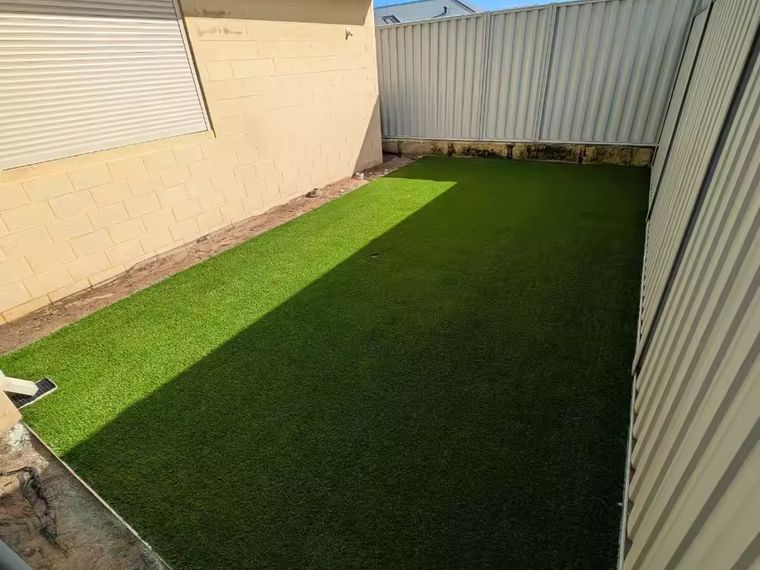
Brabham yards
Brabham, Dayton and Whiteman Edge are new estates, which changes what a turf job actually involves. There is rarely an old lawn to remove, but there is often builders fill, offcuts and compacted sand left behind from the build, and the levels are set for drainage away from the slab rather than for a finished yard.
So most of the work is under the surface. We dig out what should not be there, correct the levels, and build and compact the base properly. Done once, the lawn stays flat while the block settles over the first couple of years. Done cheaply, you get dips along the fence line inside a summer.
The other thing about a new estate is that there is no shade. No established trees, light-coloured fences, and often a west-facing yard. That pushes people towards the cooler ranges, and towards getting the turf in before the first full summer rather than after it.
Ranges
New-estate yards are usually small to medium, in full sun, and going in on a budget that already went to the build. These four cover that range.
How it works
We come to you, measure the area, check the levels and the drainage, and look at what has to come out first.
One price for the whole job. It holds unless you change the scope.
The old lawn or paving comes out and goes with us, then the base is built and compacted. That is most of the time on site.
Laid, joined, pegged and infilled, brushed up and the site left clean. Around 100 square metres a day.
We also cover Dayton, Whiteman Edge, Caversham, Bennett Springs, Belhus, Henley Brook, Malaga and the Swan Valley edge.
Other suburb guides: Fremantle, Joondalup, Canning Vale, Ellenbrook. Everywhere else is on the locations page.
Questions
Yes, and it is often easier that way. If the fences and the paving are in, we can lay turf and leave the beds for later. If the whole yard is still sand, tell us your plan at the measure so the levels work with what comes next.
Usually some of it does. Clean sand is a fine base, but building rubble, offcuts and compacted fill under the surface are not, and they are what causes dips later. We check that at the measure rather than guessing.
A properly compacted base is what stops that. We compact in layers rather than dumping and levelling once, which is the difference between a lawn that stays flat and one that follows the ground.
It gets hotter, not unusable. A cool-yarn range, a shade sail and the right infill all bring the surface temperature down. Paving in the same position gets hotter than turf does.
Start here
Six quick questions, most of them one tap, and a free on-site measure. You get a fixed written quote, not a range.