

15 Tips to Keep Artificial Grass Cooler

Perth summers are unforgiving. With temperatures regularly climbing above 38–42°C and UV Index readings in the “Extreme” category from October through March, your artificial grass can turn into a surface that’s uncomfortable or even unsafe for children and pets at peak heat.

The good news: there are 15 genuinely effective ways to keep synthetic turf cooler. Some cost nothing. Others involve a modest investment that pays off for the entire lifespan of your installation. This guide covers all of them from the fastest short-term fix (hosing it down) to the smartest long-term investment (cooling infill).

We’ve been installing artificial grass in Perth for close to a decade. We’ve seen what works in WA’s climate and what doesn’t. Everything in this guide is based on actual experience with Perth installations, not generic online advice.

Why Does Artificial Grass Get So Hot?

Before jumping to the solutions, it helps to understand why synthetic turf heats up in the first place because the reason it gets hot also points to the most effective fixes.

Natural grass stays cool through a process called transpiration: plants draw up water from the soil and release it through tiny pores in their leaves, creating a continuous evaporative cooling effect. This keeps natural grass surfaces close to ambient air temperature even on hot days.

Artificial grass cannot transpire. It has no moisture to release. Instead, its synthetic fibres often polyethylene or polypropylene absorb solar radiation and re-radiate it as heat, much like a dark-coloured surface.

Three factors make the heat worse:

  1. Colour. Darker grass fibres absorb more radiation than lighter ones. A very dark green can reach temperatures 8–12°C higher than a lighter olive or natural tone.
  2. Infill. Rubber crumb infill (the black recycled-tyre infill used in many older installations) absorbs and holds heat far more than sand or cork-based infills. If you have rubber infill and it’s too hot, the infill is likely the primary culprit.
  3. Aspect. In the southern hemisphere, a north-facing lawn receives full sun through the middle of the day — the peak heat window. A south-facing lawn stays in shade for much of the afternoon.

How Hot Does Artificial Grass Get in Perth?

Research and on-site temperature readings consistently show that unshaded artificial grass surfaces reach 50–70°C when the ambient temperature is 35–38°C. In Perth’s hottest conditions (40°C+ days), surface temperatures can briefly exceed 75°C.

How Hot Does Artificial Grass Gets

For context:

  • Water boils at 100°C
  • Most plastics deform above 80°C
  • The threshold for a skin burn from a hot surface is approximately 48°C after prolonged contact

The practical rule: On a Perth summer afternoon above 35°C, if your artificial grass is in full sun, treat the surface as you would hot concrete — don’t let children or pets walk on it without shoes or cooling it down first.

Does Artificial Grass Get Hotter Than Natural Grass?

Yes, significantly. On a 35°C day, natural grass surface temperature sits at approximately 28–32°C (staying close to or even below air temperature thanks to transpiration). Unshaded artificial grass on the same day can reach 55–65°C, a difference of 25–35°C.

This comparison changes considerably with interventions:

  • Artificial grass with HydroChill® infill: approximately 28°C cooler than standard artificial grass (back in the 27–37°C range on a 35°C day)
  • Artificial grass with shade sail (90% UV): surface temp approaches natural grass temperatures
  • Artificial grass sprayed with water: cools to near ambient within 10–15 minutes

Key message: The heat gap between artificial and natural grass is real, but it is manageable with the right product choices and a few simple habits.

15 Ways to Keep Your Artificial Grass Cool

1. Choose a Cooling Infill – The Most Effective Fix

If you have the option to choose your infill either at installation or as an upgrade, cooling infill is the single most effective heat-reduction measure available. It works continuously, 24 hours a day, without any effort from you.

HydroChill® infill works by absorbing moisture during cooler periods (morning dew, irrigation, rain) and releasing it slowly as surface temperatures rise creating a continuous evaporative cooling effect similar to natural grass transpiration. Testing shows it can reduce surface temperatures by up to 28°C compared to standard rubber infill.

Cork infill is a natural, organic alternative that doesn’t absorb as much heat as rubber. It’s a good mid-tier option for residential use and is also pet-friendly and biodegradable.

Jay’s Synthetic Grass supplies cooling infill options for Perth installations. Contact our team to discuss which infill is right for your space and climate conditions.

2. Select a Lighter Grass Colour

If you’re choosing artificial grass before installation (or considering a replacement), grass colour has a measurable impact on surface temperature. Lighter, brighter, or olive-toned grass reflects more solar radiation than dark forest-green shades.

In Perth’s climate, lighter grass varieties can run 5–10°C cooler than their darker equivalents on a 38°C afternoon. The visual difference is often subtle to the eye. Both look like natural grass at a glance but the temperature difference on bare feet is noticeable.

Ask our team to show you side-by-side swatches of darker and lighter options from our synthetic grass range. We can advise which tones tend to stay coolest in WA conditions.

3. Hose It Down for Instant Cooling

The fastest, cheapest fix available. Hosing down your artificial grass during peak heat hours (11am–4pm) can reduce surface temperature by 10–20°C within minutes through evaporative cooling.

How to do it effectively:

  • Use a garden hose on a wide spray setting you want even coverage, not a concentrated stream
  • Water the entire grass surface plus a 30cm border around the edges
  • The cooling effect lasts 15–30 minutes, so time it immediately before use
  • Repeat as needed synthetic turf doesn’t absorb water, it drains through, so there is no overwatering risk

Tip: Connect an automated timer to your garden tap and set it to run a 5-minute cycle at 10:45am and 1:45pm on hot days. You’ll cool the surface without even thinking about it.

4. Install a Shade Sail

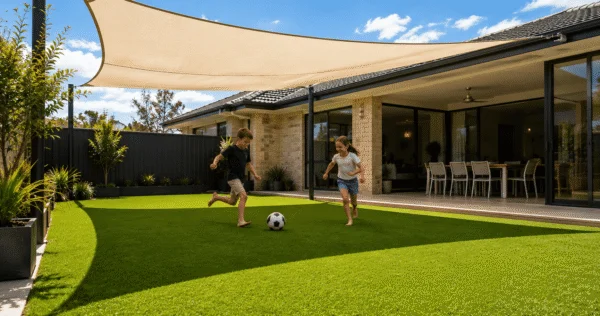
A high-quality shade sail is the most cost-effective permanent cooling solution. A shade sail with 90%+ UV blockage, covering the full grass area, can reduce surface temperatures to levels comparable to natural grass.

Key factors for maximum cooling:

  • Coverage: The sail must cover the entire turf area, including 0.5–1m of overhang on the north and west sides (where afternoon sun is most intense)
  • Angle: Angling the sail at 10–20 degrees (rather than flat) improves airflow and reduces heat buildup under the sail
  • UV rating: Choose 90%+ UV blockage (HDPE fabric) — cheaper sails offer less protection and degrade faster in Perth’s UV environment
  • Orientation: In Perth, afternoon sun comes from the north-west. Position your posts to block this angle first.

Cost: Expect $600–$2,500 for a quality shade sail and installation, depending on size and post requirements. A small garden shade sail (3×3m) can be DIY-installed for $200–$500.

5. Build a Pergola or Patio Cover

A pergola or insulated patio cover is the premium long-term shade solution. It provides reliable, year-round coverage without the lifespan concerns of fabric shade sails (which typically need replacement every 5–8 years in Perth’s UV environment).

Pergola options for Perth:

  • Timber pergola with climbing plants: Natural shade that gets denser over time; the plants add evaporative cooling through their own transpiration
  • Aluminium insulated patio: Maximum heat reduction; under a properly insulated patio cover, the grass surface will stay very close to ambient temperature even on 40°C days
  • Louvred pergola: Adjustable slats allow you to control sun/shade throughout the day

A louvred pergola or insulated patio cover will typically cost $8,000–$25,000 for a full-coverage residential installation. This is a premium option but provides the most complete cooling solution and the highest lifestyle improvement for Perth’s outdoor living season.

6. Fit Retractable Awnings

Retractable awnings offer flexibility shade when you need it, open sky when you don’t. They’re particularly useful for entertainment areas where you want sun in winter but shade in summer.

For artificial grass areas directly adjacent to the house, a motorised retractable awning (5–8m projection) can cover a substantial lawn area. Most can be controlled by remote or programmed on a timer.

Cost: $2,000–$6,000 installed for a motorised retractable awning, depending on projection and width.

7. Plant Trees and Shrubs for Natural Shade

Mature trees provide the most natural and aesthetically pleasing cooling solution and they improve over time as they grow. Large deciduous trees are ideal: they provide maximum shade in summer (when you need it) and drop their leaves in winter (when you want sun).

Best tree choices for Perth gardens:

  • Chinese Pistache (Pistacia chinensis): Fast-growing, deciduous, wide canopy, well-adapted to Perth’s alkaline soil and dry summers. Excellent shade tree.
  • Liquid Amber (Liquidambar styraciflua): Beautiful deciduous canopy, stunning autumn colours. Suits larger backyards.
  • Cape Lilac / White Cedar (Melia azedarach): Fast-growing Australian native-compatible deciduous tree extremely suited to WA’s climate.
  • Jacaranda: Provides summer shade once established; suits larger blocks.

Important: Plant at least 3–4 metres from the turf edge to prevent root encroachment under the sub-base over time. In smaller gardens, large feature shrubs (Photinia, Lilly Pilly, Acmena) along the north fence line can provide partial shade without the root risk.

8. Set Up a DIY Misting System

A misting system delivers fine water droplets at regular intervals, creating a constant evaporative cooling effect in the air above and around the grass. It’s an excellent option for entertainment areas and children’s play spaces.

DIY misting system setup for artificial grass:

What you need (from Bunnings or a plumbing supplier):

  • Drip irrigation tubing (13mm main line, 4mm micro-tubing)
  • High-pressure misting nozzles (rated for 60–80 PSI)
  • Nozzle connectors and end caps
  • Garden tap timer (set to run 5 minutes every 45 minutes during peak heat hours)

Installation:

  • Run the main line around the perimeter of the turf area at a height of 1.8–2.4m (fence-mounted or on posts)
  • Install misting nozzles every 0.8–1.2 metres along the line
  • Connect to your existing garden tap

Cost (DIY): $150–$400 in materials, depending on coverage area.

Cost (professionally installed): $800–$2,500 for a dedicated system with a timer and a second tap connection.

The cooling effect of a running misting system can reduce ambient temperature above the grass by 5–8°C, making the space significantly more comfortable.

9. Time Your Outdoor Activities

This is the zero-cost solution and one that Perth residents already know instinctively. Simply schedule grass use outside the peak heat window.

Perth summer peak heat window: 11am – 4pm (when solar radiation is most intense and surface temperatures are highest)

Best times for artificial grass use in summer:

  • Morning: Before 10:30am surface temperatures are still manageable; grass feels pleasant underfoot
  • Evening: After 5pm heat dissipates rapidly once direct sun is off the surface

For children’s outdoor play, consider setting a “grass time” rule during school holidays: morning play before 10am, afternoon play after 4pm. It’s the same approach Perth schools use for oval use during Terms 1 and 4.

10. Use Outdoor Furniture Strategically

Outdoor furniture creates zones of shade and a parasol positioned over the main seating/play area can make a meaningful difference to comfort even if it doesn’t cover the whole lawn.

Practical furniture positioning for shade:

  • Position large umbrellas (2.7m+ diameter) over the primary use zone children’s play corner, outdoor dining table, dog resting area
  • A 2.7m market umbrella provides approximately 4.5m² of shade
  • Multiple umbrellas overlapping can cover a surprisingly large area
  • Tilt-mounted umbrellas (cantilever style) are more flexible they can track the sun’s movement

Bonus: Choosing outdoor furniture in light colours (white, cream, light grey) rather than dark colours also reduces radiant heat in the surrounding space.

11. Surround the Lawn with Mulch or Rubber Mulch

Mulch along the borders of your artificial grass area reduces heat absorption in adjacent garden beds, preventing thermal radiation from surrounding soil and plants from warming the turf edge.

Best mulch types for Perth:

  • Organic mulch (wood chip, pine bark): Good moisture retention, breaks down over time to improve soil. Apply at 50–75mm depth.
  • Rubber mulch: Does not decompose; excellent for playground areas and borders. Provides a softer surface around the lawn edge. We supply rubber mulch in Perth.
  • Pea gravel / river rock: Cool to the touch, does not retain heat as much as dark soils. A pale-coloured gravel border reflects rather than absorbs sunlight.

Avoid dark-coloured decorative gravels or black polished pebbles as borders these absorb and re-radiate heat directly onto the adjacent turf edge.

12. Consider UV-Reflective Grass Coatings

UV-reflective coatings are a relatively newer category in the Australian artificial grass market. Applied directly to the grass surface, these sprays or solutions work by creating a light-reflective barrier on the fibre surface, reducing the amount of solar radiation the grass absorbs.

Current availability in Australia: Limited this technology is more advanced in the US market. Some premium installers offer it as an add-on service for sports fields and commercial installations. Ask our team whether we can source this for your installation.

Expected benefit: A 5–15% reduction in peak surface temperature. Not as effective as cooling infill or shade, but useful as an additional layer for sports and commercial venues where every degree counts.

13. Choose Grass with a Higher Pile Height

Pile height (the length of the grass blades) affects heat in a non-obvious way: taller grass blades create a slight air gap between the surface and the top of the blades, which provides mild insulation and reduces the heat felt when walking on the surface.

Grass with a 30–40mm pile height will feel noticeably cooler underfoot on a hot day than a 15–20mm short-pile product even if the overall surface temperature is similar. The blades hold you slightly above the hottest point (the infill surface) and allow air circulation between them.

For residential use in Perth, the 30–35mm range offers the best balance of cooling comfort, durability, and realistic appearance.

Visit our showroom in Malaga or Jandakot to feel the difference in pile heights in person. It’s very apparent when comparing them directly.

14. Upgrade to Cooling Yarn Technology

Some premium artificial grass products incorporate heat-reducing technology directly into the yarn itself, not just the infill. These yarns use infrared-reflecting pigments embedded in the fibre during manufacturing, which causes the blades to reflect rather than absorb solar radiation.

How it works: Standard grass fibres absorb solar radiation across the full spectrum. Cooling yarns contain pigments that reflect the near-infrared (NIR) spectrum, the main source of heat while still appearing the same colour to the human eye.

Temperature reduction: Studies on cooling yarn products show surface temperature reductions of 15–25% compared to standard yarns. On a surface that would otherwise reach 65°C, that translates to a 10–16°C reduction meaningful and noticeable.

This technology is available through select suppliers in Australia. Ask our team about cooling yarn options in our current range availability changes as new products come to market.

15. Landscape Orientation Position Everything to the North

This is a planning tip for new installations (or backyard redesigns), but it’s worth understanding regardless: in Australia, north-facing outdoor spaces receive the most direct sun.

For artificial grass cooling:

  • Best orientation for minimum heat: South-facing lawn with north-facing fence the fence provides afternoon shade
  • Worst orientation for heat: Flat, open north-facing lawn with no shade structures
  • Shade structures should prioritise the north and west faces this is where afternoon sun enters Perth backyards

When planning a new artificial grass installation, consider whether you can position the lawn to take advantage of existing shade from the house, fence, or established trees particularly on the north and north-west sides. Even partial afternoon shade makes a significant difference.

Our installation team can assess your property’s orientation during a free site visit and advise on placement for maximum comfort.

Which Cooling Infill Is Best for Artificial Grass?

Cooling Infill Is Best for Artificial Grass

Cooling infill deserves its own section because it’s the most technically significant heat-management decision you’ll make for your artificial grass installation. Here’s a detailed comparison of the four main infill types currently available in Australia:

Silica Sand Infill

Description: The most common infill type for residential artificial grass in Australia. Clean, washed, round-grain silica sand is spread throughout the grass blades to weigh them down and provide stability.

Heat performance: Moderate. Silica sand absorbs heat but also dissipates it reasonably quickly. On a 35°C day, sand-infilled grass typically reaches 50–60°C surface temperature in full sun. Better than rubber crumb; not as good as cork or HydroChill.

Cost: Lowest cost infill option. Standard for most residential installations.

Best for: Standard residential use where heat is not the primary concern. Also the best infill for areas with pets, as it’s easy to clean, doesn’t harbour bacteria, and is safe if ingested in small amounts.

Cork Infill

Description: Ground cork granules a natural, biodegradable infill option made from cork bark. Increasingly popular in Australia as an eco-friendly alternative to sand and rubber.

Heat performance: Good. Cork has low thermal conductivity compared to sand and rubber, meaning it absorbs less heat and re-radiates less. In testing, cork infill runs approximately 8–12°C cooler than rubber crumb and 4–6°C cooler than silica sand.

Cost: Moderate typically 30–50% more expensive than silica sand.

Best for: Families prioritising a natural, eco-friendly product. Also very good for pet areas cork doesn’t retain odours as strongly as rubber and is antimicrobial.

HydroChill® Technology Infill

Description: A specialised infill product that uses evaporative cooling technology it absorbs moisture from rain, dew, or irrigation and releases it slowly as surface temperatures rise, creating a cooling effect similar to natural grass transpiration.

Heat performance: Excellent. Independent testing shows HydroChill® reduces turf surface temperatures by up to 28°C compared to standard rubber crumb infill. On a 38°C day, a grass surface with HydroChill® might reach 35–40°C, a genuinely usable temperature.

Cost: Premium pricing typically 2–3× the cost of standard sand infill. However, it’s a one-time installation cost for the life of the turf.

Best for: Homes with young children and/or pets; school and childcare installations; entertainment areas where the grass is used throughout the day in summer; Perth backyards with no access to shade.

Rubber Crumb Infill

Description: Recycled rubber granules (typically from car tyres). A common infill in older installations and some sports fields due to its shock absorption properties.

Heat performance: Poor in hot climates. Rubber crumb is the hottest infill available; its dark colour absorbs maximum radiation and its thermal mass holds that heat long after the sun has moved. It is the primary reason many older artificial grass installations feel unbearably hot.

Cost: Low to moderate.

Best for: Sports applications in cooler climates, or indoor/covered venues where heat is not a concern. Not recommended for residential Perth lawns or any application where children and pets use the surface in summer.

If you currently have rubber crumb infill and your grass runs too hot, contact us to discuss an infill replacement. We can top-dress your existing turf with cork or sand infill without a full reinstallation.

FAQs

Unshaded artificial grass in Perth can reach surface temperatures of 50–70°C when the ambient temperature is 35–38°C. On extreme days (40°C+), surfaces can briefly exceed 75°C. Adding shade or cooling infill can reduce this by 15–30°C, bringing the surface into a comfortable, usable range.

HydroChill® infill provides the greatest cooling up to 28°C reduction compared to rubber crumb. Cork infill is a natural mid-tier option (8–12°C reduction). Standard silica sand is better than rubber crumb but not as effective as the specialist cooling products. See the infill comparison section above for full details.

Yes, it’s the quickest and easiest heat fix available. Hosing down synthetic turf reduces surface temperature by 10–20°C within minutes through evaporative cooling. Since the grass is permeable, water drains through quickly and the surface doesn’t become muddy. The cooling effect lasts 15–30 minutes.

In direct afternoon sun above 35°C, the surface can be too hot for bare feet. The simple rule: if it’s too hot for your bare foot, it’s too hot for children. Schedule play before 10:30am or after 4:30pm (after the Fremantle Doctor arrives), or hose down the surface before use. A shade sail covering the play area is the most practical permanent solution.

Both materials get very hot in full sun. Unshaded artificial grass can reach similar or slightly higher temperatures than concrete. However, artificial grass loses heat faster once shaded and feels more comfortable underfoot due to air circulation between the blades. With cooling infill, artificial grass can actually feel cooler than adjacent concrete paving.

Cooling infill costs vary by product and volume. Standard silica sand infill is the most affordable. Cork infill is typically 30–50% more expensive than sand. HydroChill® and other specialist cooling infills are premium products. Contact Jay’s Synthetic Grass for a specific quote based on your lawn size and the infill product you’re interested in.

In most cases, yes. Existing installations can be top-dressed with a cooling infill without removing the existing infill, provided the drainage isn’t already fully blocked. This is a cost-effective way to significantly reduce surface heat without replacing your entire turf. Contact us to assess your existing installation.

Choose a shade sail rated at 90%+ UV blockage (HDPE fabric). Lower-rated sails provide less protection and also degrade faster under Perth’s extreme UV exposure. At 90%+ UV blockage, a properly oriented shade sail will reduce the turf surface temperature to levels approaching natural grass making the space genuinely usable through Perth’s summer afternoons.

If you’re considering artificial grass for your Perth home or commercial property and want to ensure it stays comfortable year-round, Jay’s Synthetic Grass can help you design the right system from the start: the right fibre, the right infill, and the right shade strategy for your specific block, orientation, and lifestyle.