Why Natural Grass Fails in High-Traffic Areas
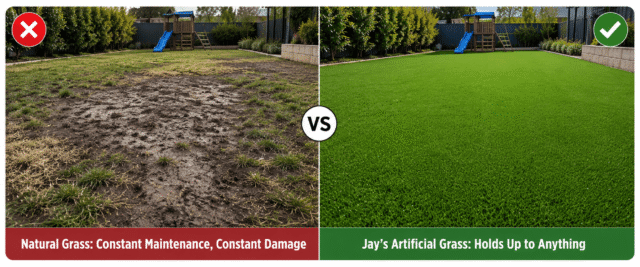
Perth’s climate is hard enough on natural grass without adding heavy use on top. Summers are long, hot, and dry. Reticulation restrictions limit watering frequency. And when a lawn is also absorbing constant foot traffic, the result is predictable: compacted soil, bare patches, muddy ruts, and a surface that looks neglected no matter how much effort you put in.
Natural grass relies on the soil beneath staying loose and oxygenated enough for root growth. Foot traffic compacts the soil, cutting off that oxygen supply. Once compaction sets in, grass roots can’t recover, and the surface turns to bare dirt especially in Perth’s sandy soils, which compact and drain quickly but don’t support root regrowth under pressure.
Common Damage Patterns in Perth Backyards
The pattern is almost identical across Perth properties:
- Goal-mouth and run-up zones — worn completely bare by repetitive movement on the same path
- Dog circuits — pets run the same perimeter loop until the grass is gone
- Entry points and gates — foot traffic concentrates at transitions between indoor/outdoor, eliminating grass within a season
- Under climbing frames and swings — impact zones wear through rapidly and become muddy hazards
These areas don’t need more water or more fertiliser. They need a surface that doesn’t rely on biological root systems to stay intact.
What Makes Artificial Grass Handle Heavy Traffic?
Not all artificial grass is created equal, and this matters most in high-traffic environments. A budget decorative turf with a long, soft pile and a thin backing will flatten under sustained use. Here’s what separates high-traffic grade turf from standard residential products.
Pile Height: Shorter is Tougher
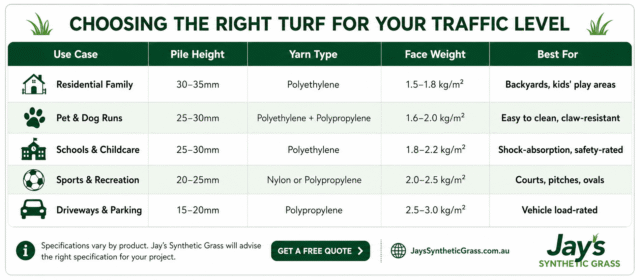
Counterintuitively, shorter pile artificial grass performs better under heavy use than longer, lush-looking turf. A pile height of 20–30mm is the sweet spot for high-traffic applications:
- Shorter fibres recover more quickly after compression they spring back faster under repeated foot traffic
- Less fibre surface area means less matting over time
- Easier to clean, brush, and maintain
- More resistant to the heat-flattening effect Perth summers cause in longer-pile products
Longer pile heights (35–50mm) are ideal for decorative residential lawns with light use, where the aesthetic priority is lush appearance. For any area that sees regular, heavy use, opt for 20–30mm.
Yarn Material: Polyethylene, Nylon, and Blends
The fibre material determines both feel and durability:
Polyethylene (PE): The most common material for residential and light commercial turf. Soft underfoot, realistic appearance, good UV resistance. Suitable for moderate-to-heavy residential use and light commercial applications.
Nylon: The most durable synthetic turf fibre available. Extremely resilient, springs back after heavy compression (including furniture and equipment), and maintains its shape over years of intense use. Higher cost, slightly stiffer underfoot. Ideal for sports areas, commercial entryways, and anywhere with consistent heavy traffic.
Blended (PE + Nylon): Combines the softness of polyethylene with the structural recovery of nylon. A popular commercial choice that balances comfort with durability. Most quality high-traffic products use this approach.
Polypropylene (PP): Budget-friendly but not recommended for high-traffic areas. Less resilient and will flatten under sustained use.
Backing Strength and Drainage
The backing is the foundation of the turf, the layer that holds the fibres in place and sits on your sub-base. For high-traffic applications:
- Double-layered or reinforced polyurethane backing ensures the turf doesn’t wrinkle, lift, or separate from the sub-base under load
- High tuft bind – a measure of how firmly fibres are locked into the backing prevents fibre pull-out under aggressive use
- Drainage perforations of at least 30–40 holes per square metre ensure quick water clearance, preventing the surface becoming slippery or waterlogged after Perth’s winter rain events
UV Stability in Perth’s Climate
Perth receives some of the highest UV intensity of any major city in the world. Turf without proper UV stabilisation will fade, become brittle, and shed micro-fibres within 2–3 years in direct sun. All quality high-traffic products should carry:
- UV inhibitors integrated into the yarn manufacturing process (not a surface coating, which wears off)
- A minimum 8–10 year UV fade warranty from the manufacturer
- Demonstrated performance in Australian climate conditions specifically
Residential High-Traffic Applications
For Perth homeowners, the most common high-traffic challenges fall into three categories. Each has slightly different turf requirements.
Family Backyards and Kids’ Play Areas
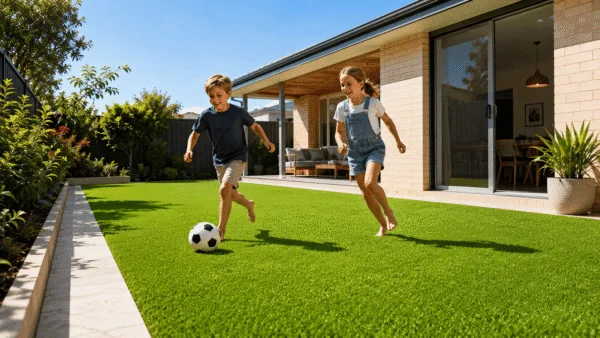
Children are the most relentless traffic generators in any backyard. A well-used family lawn might see 4–6 hours of active use per day during school holidays – running, jumping, rolling, and dragging play equipment across the surface.
For family backyards with children, we recommend:
- Pile height: 25–35mm (enough softness for play, short enough to recover)
- Pile material: Polyethylene blend – soft underfoot for bare-skin contact
- Infill: Silica sand infill to maintain pile support and cushioning
- Optional: A shockpad layer beneath the turf for added impact absorption, particularly under climbing frames and trampolining areas
The result is a surface that stays green and even regardless of how many kids use it or how long the dry season lasts. No reseeding after the school holidays. No muddy children coming inside.
Pet Runs and Dog Yards
Pet use presents a different challenge to foot traffic – pets tend to run the same circuits repeatedly, concentrating wear, and their waste requires drainage and easy cleaning.
For dog yards and pet runs:
- Drainage is critical – choose turf with 30+ drainage holes per square metre
- Short pile (20–25mm) is easier to clean and hose down
- Anti-odour infill (zeolite-based) prevents ammonia odour buildup in frequently used areas
- Reinforced backing prevents digging behaviour from damaging the turf structure
Jay’s pet-friendly artificial grass range is specifically configured for pet households.
Driveways and Parking Areas
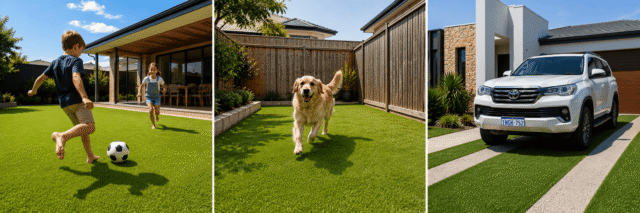
Can you use artificial grass in a driveway or parking area? Yes, but standard residential turf will not hold up. Vehicle weight (a typical passenger car weighs 1,200–2,000kg) requires:
- Commercial-grade backing: Standard residential backing will compress and crack under vehicle loads
- Heavy-duty sub-base compaction: The gravel and crushed limestone base must be deeper and more thoroughly compacted than for a standard lawn installation
- Low pile height (20mm or under): Taller pile will flatten immediately under tyre pressure
- Restricted to occasional parking only: For regular daily vehicle access, alternatives such as permeable pavers with turf inserts are a more durable solution
Jay’s installation team can assess your driveway or parking area and advise on the appropriate specification. Contact us for a site assessment.
Commercial and Industrial Applications
Artificial grass has moved well beyond residential backyards. Across Perth and regional WA, commercial and industrial operators are using synthetic turf to solve problems that natural grass simply cannot handle in high-demand environments.
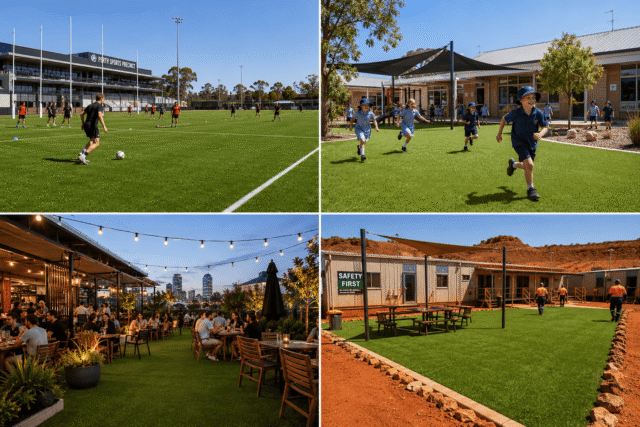
Sports Fields and Training Grounds
Sports environments represent the most demanding high-traffic application for artificial grass. Synthetic turf designed for sporting use must:
- Withstand multi-directional cutting, sprinting, and sliding movements without fibre breakdown
- Provide consistent surface grip and ball roll characteristics
- Drain rapidly to allow play to resume after rain
- Maintain a safe, even surface without the bare patches and ruts that develop on natural grass
Jay’s installs [artificial grass for sports applications] across Perth, from residential backyard putting greens and basketball half-courts to full commercial training facilities. For high-performance sports use, we source products with specific sport-rated specifications.
Schools and Childcare Centres
School grounds and childcare centres are among the highest-traffic environments; any outdoor surface faces hundreds of children using the same relatively small area, multiple times per day, every school day.
The key requirements for school and childcare environments:
- Safety compliance: Fall-height rated surfaces are required under playground equipment; shockpad systems must be installed to meet Australian Standards
- Hygiene: The surface must be easy to clean and must not trap biological contaminants
- Durability: A school lawn needs to last 10+ years; the ROI calculation compared to continuously reseeding natural grass is compelling
- Zero maintenance: School grounds staff are not landscapers; a surface that needs zero mowing, watering, or fertilising is a significant operational benefit
Jay’s has installed artificial grass in schools and childcare centres across Perth. View our commercial projects page for case studies.
Restaurants, Bars, and Hospitality Venues
Outdoor dining and bar areas have specific challenges: constant table and chair movement, food and beverage spills, high-heel traffic, and the need for a surface that looks premium enough to match the venue’s atmosphere.
Artificial grass works exceptionally well in hospitality settings because:
- It maintains its appearance regardless of foot traffic volumes – no seasonal reseeding or watering required
- Spills clean up easily with water – beer, wine, and food waste don’t stain quality synthetic turf
- Modern artificial grass products look genuinely premium – a well-chosen product complements outdoor dining aesthetics far better than patchy, worn natural grass or plain timber decking
- It can be installed on concrete or existing paved surfaces, eliminating the need for soil preparation
Jay’s has supplied and installed artificial grass for [restaurants and commercial venues] across Perth. Contact our commercial team for a tailored quote.
Mine Sites and Industrial Areas (WA)
Western Australia’s mining industry operates some of the most remote, resource-limited worksites in the country. Artificial grass has become a practical solution for:
- Recreation areas and crib rooms: Workers benefit from green, natural-looking spaces during breaks; maintaining natural grass in remote Pilbara or Goldfields conditions is impractical or impossible
- Accommodation villages (fly-in, fly-out): High-traffic communal areas need a surface that handles hundreds of workers with zero maintenance
- Site offices and visitor areas: Professional presentation without the overhead of grounds maintenance staff
- Dust suppression: Ground-covering turf in trafficked outdoor areas can reduce the dust generated by bare ground in dry conditions
Key requirements for mine site artificial grass differ from residential applications:
- Zero water requirement: No irrigation infrastructure needed at remote sites
- Extreme UV resistance: Pilbara and Goldfields UV exposure is among the highest in the world
- Heat resistance: Surface temperatures on mine sites can exceed 60°C; quality turf with proper infill manages heat better than bare ground and many alternative surfaces
- Durable commercial backing: Mine site use is unrelenting; residential-grade products are not appropriate
Jay’s Synthetic Grass has experience supplying and installing artificial grass for [WA mine sites and industrial applications]. Contact our commercial team to discuss your site requirements.
How to Choose the Right High-Traffic Artificial Grass
With dozens of artificial grass products available at varying price points, choosing the right one for a high-traffic application comes down to matching the product specification to the use pattern. Here’s a simplified framework.
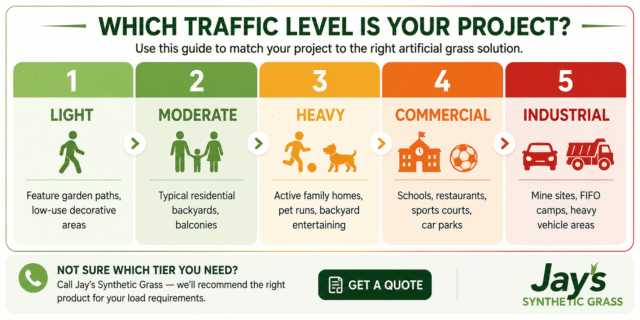
Traffic Load Classifications