

Is Artificial Grass Toxic to Dogs and Cats?
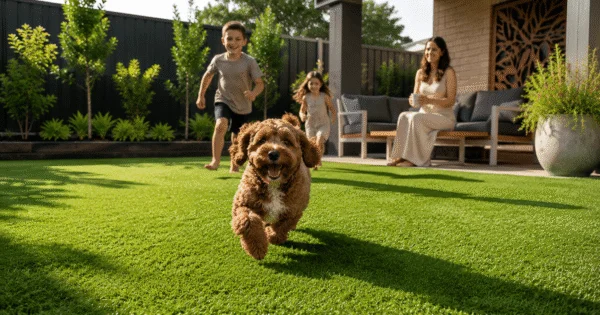
This is the question every responsible pet owner asks first. The honest answer: modern, quality artificial grass from reputable suppliers is non-toxic. But not all artificial grass products are equal, and some older or cheaper products can contain harmful substances.
What Materials Are Used in Artificial Grass?
Modern artificial grass is manufactured from two primary fibre materials:
Polyethylene (PE): The most common fibre used in residential and pet-friendly artificial grass. Soft, flexible, and non-toxic. This is the same material used in food-grade plastic bottles and containers, a reassuring benchmark for safety.
Polypropylene (PP): A harder, more rigid fibre often used in commercial or sports-grade turf. Also non-toxic, though slightly less soft underfoot than polyethylene.
Both polyethylene and polypropylene are inert synthetic plastics, they don’t off-gas chemicals under normal conditions, they don’t react with soil or water, and they won’t cause poisoning if small amounts are ingested. This is the baseline safety of all quality artificial grass.
The backing material, the layer that holds the fibres in place, is typically polyurethane or latex. Both are safe. The drainage holes in the backing are a critical feature for pet areas: they allow urine to drain away quickly, preventing pooling and odour buildup.
At Jay’s Synthetic Grass, all our products are manufactured from PE and PP fibres with polyurethane backing. No harmful additives. Our full pet-friendly range can be viewed at our Malaga or Jandakot showrooms.
Lead-Free Artificial Grass – Why It Matters
This is the most important chemical safety consideration when choosing artificial grass for pet households.
The problem with older turf: Some artificial grass products particularly older products and cheap imports use lead-based pigments to achieve green colour. Lead is toxic to both animals and humans. Dogs that repeatedly contact, lick, or chew lead-containing turf are at risk of lead poisoning over time.
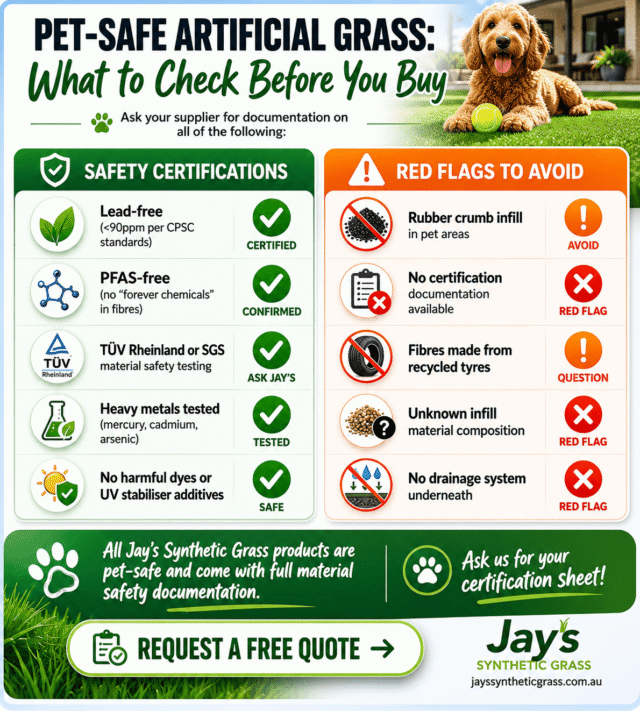
What to check: Reputable artificial grass suppliers test their products for heavy metals including lead. Ask your installer for a product data sheet or safety certificate confirming the turf is lead-free and tested to Australian or international safety standards (look for references to REACH, EN71, or AS/NZS standards).
At Jay’s: All our artificial grass products are sourced from manufacturers with documented heavy metal testing. When you buy from us, you are not buying cheap imported turf of unknown origin. We can provide product data sheets on request.
What About PFAS “Forever Chemicals”?
PFAS (per- and polyfluoroalkyl substances) commonly called “forever chemicals” have been in the news in recent years due to their persistence in the environment and potential health concerns.
Are they in artificial grass?
Some studies have detected trace PFAS in certain artificial grass products, primarily in infill materials and some backing treatments. The science is still evolving, but it’s a legitimate concern.
Practical guidance for Perth pet owners:
- Choose artificial grass from suppliers who can confirm their products are PFAS-free or PFAS-tested
- Silica sand infill and cork infill are the safest infill choices for pet areas from a chemical standpoint
- Avoid recycled rubber crumb infill if PFAS exposure is a concern recycled tyre rubber has been associated with higher PFAS levels in some testing
Jay’s Synthetic Grass sources products from manufacturers with up-to-date chemical safety documentation. Contact us to discuss PFAS-free options if this is a priority for your household.
Is It Safe If My Dog Eats or Chews Artificial Grass?
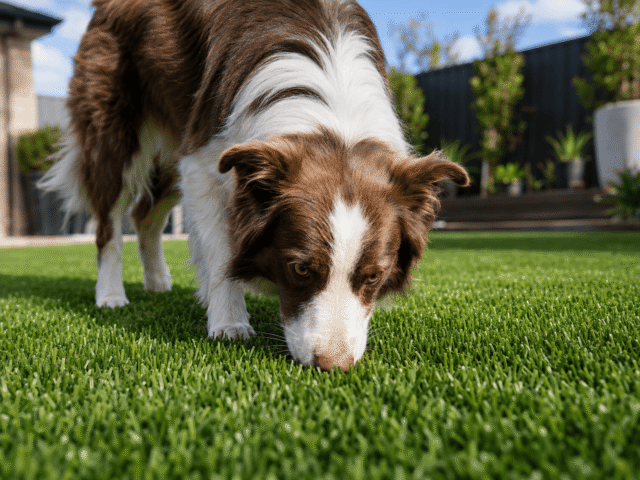
Dogs are curious and chew on everything, including the lawn. Here’s the honest answer:
Small amounts of high-quality PE/PP artificial grass fibre are unlikely to cause serious harm. The material is chemically inert and similar to other non-digestible materials dogs occasionally ingest. However, eating artificial grass is not safe and should be discouraged for these reasons:
- Digestive blockage risk: Larger amounts of synthetic fibre can cause a blockage in the digestive tract the same risk as a dog eating rope toys or carpet
- Infill ingestion: If the turf contains rubber crumb infill, chewing exposes the dog to rubber particles, which can cause gastrointestinal irritation and, in older rubber crumb products, chemical exposure
- Repeated chewing damages the turf and shortens its lifespan
If your dog regularly chews the turf: Consult your vet. Also consider a no-dig border (a deeper edging profile that makes it harder to lift the turf edge) and choose turf without rubber crumb infill to reduce the risk from any chewing that does occur.
Are There Pet-Safe and Pet-Unsafe Infill Types?
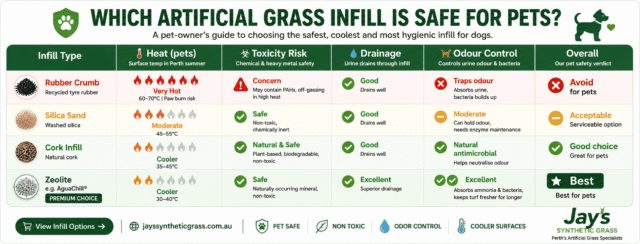
The infill material the granules spread through the grass blades for stability and cushioning is a critical consideration for pet households. Infill types vary significantly in safety, hygiene performance, heat absorption, and odour control.
Infill Types Safe for Pet Areas
Silica Sand: The most common infill for residential pet areas. Clean, washed silica sand is non-toxic, drains well, is easy to clean, and doesn’t harbour bacteria. If accidentally ingested in small amounts, it causes minimal harm. Silica sand is the standard recommendation for most Perth pet households.
Cork Infill: A natural, biodegradable option made from cork bark. Cork is antimicrobial; it naturally inhibits the growth of bacteria and mould making it an excellent choice for pet areas where hygiene is a priority. It also stays cooler than rubber crumb (important for Perth summers and dog paws). Slightly more expensive than sand, but a premium choice for pet safety.
Zeolite Infill: A naturally occurring mineral specifically used in high-pet-use areas for its exceptional odour control properties. Zeolite absorbs ammonia from urine, neutralising odour at the source rather than just masking it. Particularly useful for dog runs with high urine load. Often blended with silica sand for best results.
Infill Types to Avoid with Pets
Rubber Crumb (Recycled Tyre Infill): We strongly advise against rubber crumb infill for pet areas, for three reasons:
- Heat: Rubber crumb is the hottest infill available on a Perth summer day, it can make the turf surface reach 65–70°C, far beyond what’s safe for dog paws
- Ingestion risk: If your dog chews the turf, rubber crumb is the most concerning infill to ingest older recycled tyre rubber can contain chemical compounds including zinc, hydrocarbons, and in some cases PFAS
- Odour retention: Rubber crumb absorbs and holds odour more than sand or cork, which is particularly problematic in pet areas
If your existing installation has rubber crumb infill: Contact us to discuss a top-dressing replacement with silica sand or cork. This can often be done without removing the turf.
Does Artificial Grass Harbour Fleas, Ticks or Bacteria?
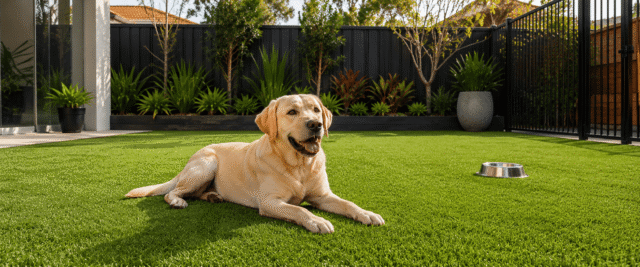
Flea and Tick Risk on Artificial vs Natural Grass
Artificial grass is significantly less hospitable to fleas and ticks than natural grass and this is one of the most underappreciated benefits for Perth pet owners.
Fleas and ticks require specific conditions to thrive: moist organic soil, leaf litter, and sheltered microhabitats between grass blades. A properly installed artificial grass area with a compacted sub-base, good drainage, and synthetic fibres eliminates the soil environment that fleas need to complete their lifecycle.
What the research shows:
- Flea larvae cannot survive in a dry, synthetic environment they require humid organic matter to develop
- Tick populations are closely tied to vegetation and soil moisture artificial grass provides neither
- Perth pet owners who switch from natural to artificial lawns commonly report a significant reduction in flea problems in the areas where turf is installed
Important caveat: Artificial grass is not a flea treatment. Your dog can still pick up fleas from parks, other dogs, or any natural grass area and bring them inside. Maintain your regular vet-recommended flea prevention regimen regardless of your lawn surface.
Bacteria and Hygiene on Pet Turf
The honest concern: dog urine and faeces left unmanaged on artificial grass can create bacterial growth primarily E. coli, Salmonella, and other enteric bacteria from pet waste.
The good news: A properly installed pet turf system is designed to manage this:
- Good drainage removes urine from the surface quickly, before bacterial colonies can establish
- Regular hosing (at least weekly) flushes the infill and backing to remove bacterial load
- Antimicrobial infill (cork, zeolite) actively inhibits bacterial growth at the surface level
- Anti-odour treatments like Jay Fresh use enzyme technology to break down organic waste residue at a molecular level eliminating the biological material that bacteria feed on
The risk increases when:
- Waste is left on the surface for extended periods without removal
- The drainage system is partially blocked by debris or compacted infill
- High pet use (multiple dogs, daily use) exceeds the system’s cleaning capacity without regular intervention
Practical rule: Remove solid waste immediately. Hose the area daily if you have multiple dogs. Use Jay Fresh or equivalent enzyme cleaner monthly.
How to Clean and Maintain Artificial Grass with Pets
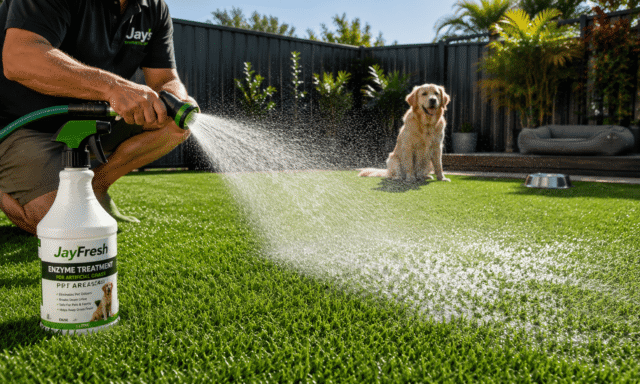
Daily and Weekly Cleaning Routine
Daily (takes 2–3 minutes):
- Remove solid waste immediately use a bag or scoop, just as you would in a park
- Rinse the solid waste area with water from a hose
- Check for any debris (leaves, food scraps) on the surface these break down and create organic material for bacteria
Weekly (takes 5–10 minutes):
- Hose the entire artificial grass surface thoroughly this flushes urine residue through the drainage system and prevents bacterial build-up
- Brush the grass blades with a stiff-bristle broom or leaf blower to restore upright blade position and remove any compacted debris
- Check the perimeter edging for any lifting or damage especially if you have a digging dog
For multiple dogs or high-use pet areas: Rinse daily instead of weekly.
Managing Pet Odour
Odour in artificial grass pet areas is caused by ammonia from urine that hasn’t fully drained through or has been absorbed by the infill. There are three levels of odour management:
Level 1 — Prevention (regular hosing): The simplest approach. Urine that drains through quickly before it can decompose causes minimal odour. Weekly hosing is sufficient for light-use areas (one small to medium dog).
Level 2 — Enzyme treatment (monthly): Jay Fresh – our enzyme-based anti-odour solution breaks down the organic molecules in urine and waste residue, eliminating odour at the source rather than masking it. Apply monthly for light use, fortnightly for heavy use (multiple dogs, large breeds). Dilute as directed and apply with a watering can or pump sprayer over the full grass area.
Level 3 — Infill replacement (if odour persists): If an installation has been maintained without enzyme treatment for an extended period, the infill itself can become saturated with odour-causing material. In this case, a professional infill flush or partial infill replacement may be needed. Contact us to discuss options.
Deep Cleaning – Step-by-Step
Every 3–6 months (more frequently for heavy pet use), perform a full deep clean:
What you need:
- Garden hose with strong spray setting
- Stiff-bristle broom or power brush
- Enzyme cleaner (Jay Fresh or equivalent)
- Leaf blower (optional but helpful)
Steps:
- Leaf-blow or rake all debris from the surface
- Remove any loose infill that has compacted on the surface
- Hose the entire area thoroughly work methodically from one end to the other
- Apply diluted enzyme cleaner (Jay Fresh) over the full surface concentrate on high-use zones (dog toilet areas, entry/exit points)
- Allow the enzyme cleaner to sit for 10–15 minutes don’t rinse yet
- Hose again thoroughly to flush the enzyme cleaner through the drainage
- Use the stiff broom to brush the blades back to upright position
- Allow to dry (this is fast most Perth surfaces dry within 30–45 minutes on a warm day)
What to avoid:
- Bleach and bleach-based disinfectants — can leave residue that irritates paw pads and degrades the turf backing over time
- Steam cleaners — excessive heat can damage the turf fibres and backing adhesive
- Pressure washers at very high pressure — can displace infill and damage the fibre-backing bond; a standard hose with good water pressure is sufficient
Benefits of Artificial Grass for Perth Pet Owners
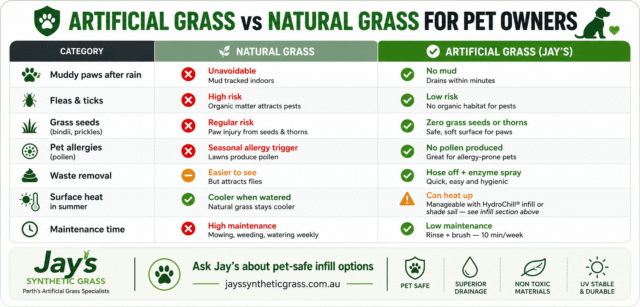
Beyond safety, artificial grass offers genuine lifestyle advantages for Perth pet owners:
No mud, ever. Perth winters bring enough rain to turn natural grass areas particularly under heavy dog traffic into mud pits. Artificial grass drains quickly and stays clean year-round. Say goodbye to muddy paw prints through the house and muddy dog bath sessions after every rainy day.
No allergens from grass pollen. Many dogs (and cats) suffer from environmental allergies triggered by grass pollen, lawn fungal spores, or pesticide residue from natural lawn treatments. Artificial grass eliminates all three. If your pet has been suffering from persistent itching, sneezing, or paw-licking that worsens in spring and summer, the lawn is a likely allergen source.
No toxic lawn chemicals. Maintaining natural grass requires fertilisers, herbicides (weed killers), and sometimes pesticides — all of which are toxic to pets at various concentrations. Artificial grass requires none of these. Zero chemical exposure from lawn maintenance.
Durable against heavy use. A natural grass dog run becomes a muddy, bare-soil disaster within weeks for most medium-to-large breeds. Artificial grass designed for pet areas can withstand years of heavy daily use from large, active dogs without visible wear.
Consistent year-round surface. No bindi or prickle weeds that cause paw injuries; no bare patches where soil is exposed; no seasonal lawn disease that creates fungal risks. Artificial grass provides a consistent, safe surface in all seasons.